An examination of Peg Powler
‘The peculiar disposition of rock, well and stone, and the snatches of the past which the modern couple glimpse through the valley’s mist, increasingly tap into a deeper, more primeval kind of memory, as the past bleeds into the present, drawing it’s energy from an even deeper, mythic prehistory’
The Land of the Green Man – Carolyne Larrington
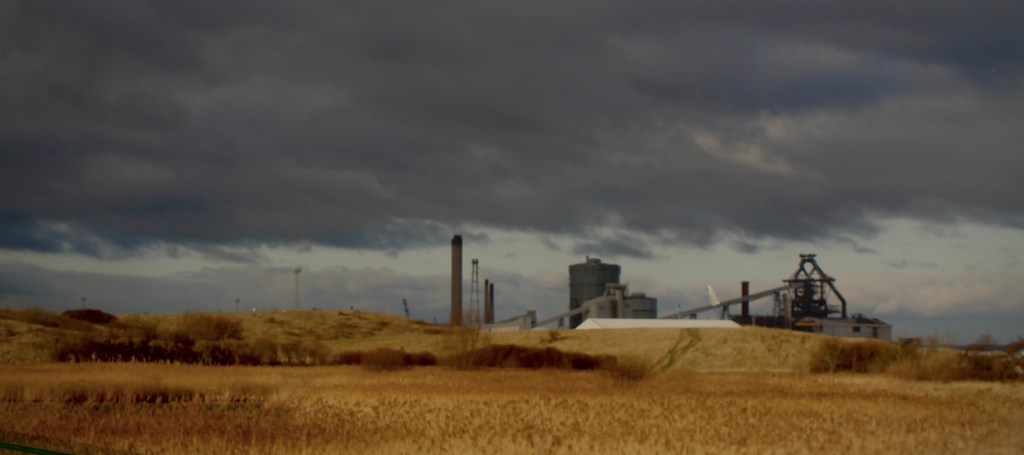
Teesside is a land of industry. Cold, grey towers pierce a clear blue sky. From a distance you might see flames seemingly suspended in the air; a closer inspection showing excess gas being burned in the night. If you were to walk through the area you would see a landscape filled with metal; rusted old train carriages abandoned in the grass, silos rising up like goliaths behind the ancient hills, young trees growing up through desolate bridges. You would think a land so defined by it’s industry would have no place for myths and magic but, like the trees grappling with the bridges, most of our myths have adapted to the new landscape. As a child I remember being convinced that a monster roamed the works at night, and the sirens it emitted were the creature’s screams. Children were warned away from the abandoned trains with tales of a wild man who lived there; hungry for blood.
One story that has remained mostly unchanged is that of Peg Powler, a water spirit who resides within the river Tees. Like many water spirits, no one can decide precisely what she is. Is she one of the Fae? Perhaps angered by humanity’s constant destruction of the lands around the river she makes her home? Is she a poor serving girl, killed by the callousness of her mistress – fated to forever haunt the shores of her watery grave? Local legend points to the latter – but do the historical facts?
There are several legends of women meeting unfortunate ends in the river Tees. A man, convinced that his wife was having an affair with a local baron, reportedly decapitated her and dumped her body in the water. Her ghost sometimes appears around the Tees; dressed in a long white gown. She certainly doesn’t sound much like Peg Powler – a creature truly at one with the river. Long green hair filled with moss and lichen, mottled skin and, like her Lancashire cousin ‘Jenny Greenteeth’, a smile to strike fear into the hearts of even the burliest of workers. The most enduring of tales is that of Peg O’Nell; a serving girl in Waddow Hall. The mistress of the hall was said to have cursed poor Peg, hoping that she’d trip and break her neck on the ice. The curse succeeded, and Peg’s body was found in the snow the next day; neck bent to an unnatural degree. Not long after the tragic incident, strange things began happening at Waddow Hall. Livestock would go missing, and the children of the Hall grew sick. Superstitious locals started to believe that the vengeful ghost of Peg O’Nell endured; seeking to bring ruin to the cruel mistress who killed her. But Peg’s desire for vengeance wasn’t limited to the Hall itself; once every seven years, on the anniversary of her death, animals would wash up on the shores of the river Tees – beloved dogs, cats and even wild birds, claimed by the waters. This night became known as ‘Peg’s night’; and it was said that if Peg wasn’t satisfied with the life of an animal, she would claim the life of a human. They say that on one such night a young man, determined to cross the river (and unaffected by local superstitions), began to cross the bridge over the teeming waters. He never reached the other side.
The sad tale of Peg O’Nell may be the most enduring of explanations; but I do not believe it to be the most compelling. Precisely why Peg would choose to haunt the river, when she didn’t die in it, is a mystery. And why would she require a sacrifice only once every seven years?
There is another creature that, in some tales, requires sacrifices in seven year cycles; fairies. In the Scottish ballad The Tale of the Young Tamelene, the main character (the lecherous fairy Tam Lin) fearfully tells a tale of how once every seven years his people make a sacrifice, and send one of their own to Hell. Of course this is a Christianised tale – I’m not sure the Fae have much to do with either heaven or hell – but it is a good example of how old stories sometimes mingle with new ones; adding modern thought to ancient wisdom. I believe that this is what happened to the tale of Peg Powler – in times beyond record she was likely a fairy, or a water spirit; perhaps even a local deity. As Christianity took over, and tales of the Fae lost popularity in England, the population of Teesside reconciled the old mythology with new logic – if she is not an ancient creature, living beside us unseen, then she must be some unfortunate soul, filled with too much vengeance and hate to move on to the Kingdom above. Poor Peg O’Nell, or the unnamed woman murdered by her husband, likely fitted the bill perfectly.

Water spirits are common around the world, and they are rarely benevolent. You might think of the Little Mermaid as a kindly creature who wanted nothing more than to walk the land as a human – but most mermaids of British lore were dangerous creatures, wishing for nothing more than to drag men down to a watery grave. The Scottish Kelpie can fuse a human to it’s fur, and carry them straight into it’s river or lake (don’t worry – you can escape simply by cutting off your own fingers). Some Kelpies, such as the Kelpie of River Conon, even had the ability to curse men who evaded them into drowning in shallow puddles. The reason why these spirits are considered dangerous is obvious – the water that they live in is the real danger. Kelpies and Mermaids can be seen as metaphors for the current that sweeps careless swimmers away. And Peg Powler could be a way of explaining away the bodies of unfortunate people who have washed up on the shores of the river Tees. People sadly drown more frequently than once every seven years in our river, and it’s considerably more likely that they died due to mixing up which side of the river is safe to swim in; the river is split in two – one side tidal, one non-tidal. Swimming in the tidal side of the river is incredibly dangerous, vengeful hag or no vengeful hag.
Peg’s has proven to be an enduring tale, and she’s lasted longer than Teesside’s industry; our steelworks are being demolished as I type this. There’s something to be said for the longevity of folklore – especially in an increasingly secular society. Tales of a scary, green haired, water-woman prove to be far more effective a warning for children than explaining boring old water safety regulations. That isn’t to say that she doesn’t exist, in some capacity. Peg Powler exists for those who believe in mystical creatures such as the Fae, or ghosts, or even Tulpas. For those, such as myself, who believe in a John Keel-esque world of high strangeness – she is a contactable entity, both real and unreal.
References –
Brockie, William. Legends & Superstitions of the County of Durham. B Williams, 1886.
Mitchell, W. R. Yorkshire Ghosts. Dalesman Publishing Co, 1977.
Leach, Maria. The Standard Dictionary of Folklore, Mythology and Legend. Funk & Wagnalls Company, 1949.
Larrington, Carolyne. The Land of the Green Man. Bloomsbury Academic, 2015.
 tinyghoul productions